
What is a first course block?
A first course block is the unit used in the bottom course of a wall, laid straight onto the foundation or the floor slab. Together those blocks form the levelling course — the first course, set dead level, on which the whole wall is then built. The Dutch term is kimblok, from kim, meaning edge: […]
What is a metal waterstop?
A metal waterstop is a steel strip cast half into the first pour and half into the next, so water cannot track along the joint between them. Its most common position is the wall-floor joint, where the slab meets the rising wall. Construction joints and shrinkage joints are sealed the same way. The principle is […]
What is kicker formwork?
Kicker formwork is the shuttering used to cast a kicker: a low concrete upstand on the floor slab, exactly on the line and to the thickness of the wall that will follow. Once that kicker has hardened it forms the clamping face and starting point for the wall formwork. In in-situ concrete work this is […]
What is a formwork base anchor?
A formwork base anchor is a spacer for wall formwork that is pushed into still-fresh concrete at the kicker position — where the wall meets the floor slab. Once the concrete has hardened the anchor is locked in place and forms the starting point that both formwork panels are clamped against. The bottom of the […]
What is a worm’s-eye view?
A worm’s-eye view is a perspective drawing or image taken from a very low viewpoint — close to the ground, as if you were looking up from below. Everything above eye level looks tall, imposing and steeply converging. It is the opposite of a bird’s-eye view, where you look down on the object from high […]
What is a rope cleat?
A rope cleat is usually a metal double hook — a T-shaped or anchor-shaped fitting — around which a rope or line is belayed in figure-of-eight turns. You find them on flagpoles, scaffolds, boats and anywhere a line has to be made fast quickly and released just as quickly. The Dutch term for it, kikker, […]
What is pea gravel concrete?
Pea gravel concrete is concrete in which the coarse aggregate is not ordinary gravel but fine, rounded pea gravel of roughly 2 to 8 mm. Because the largest stone stays small, the mix can be placed in a much thinner layer than normal structural concrete without becoming coarse and crumbly. Pea gravel is small, rounded, […]
Wood Stove Installation: Costs, Permits and Regulations (2026)

Energy prices fluctuate, dependence on gas feels vulnerable, and more and more homeowners are looking for an independent heat source. A wood stove delivers not just atmosphere but serious warmth: a modern stove easily heats 60 to 120 square metres. The total cost for a complete installation ranges from €3,500 to €7,000, including stove, flue […]
How to Set Up Drip Irrigation in Your Garden: Save Up to 70% Water With This Guide (2026)
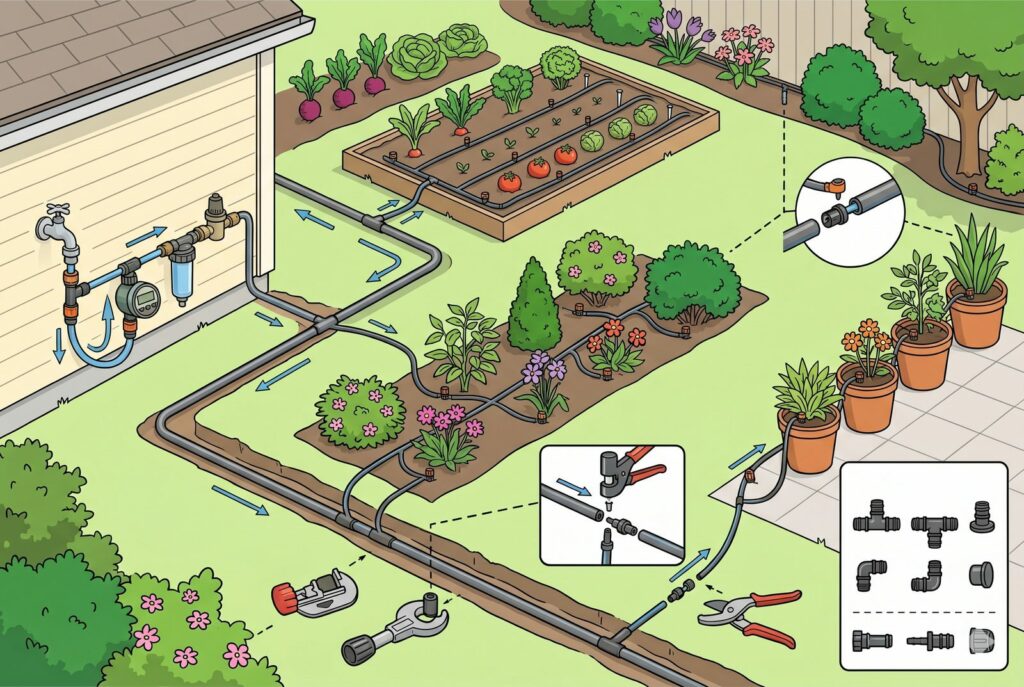
Every summer the same story: you’re standing in the garden daily with a hose, using hundreds of litres of water while half of it evaporates before reaching the roots. An average household uses 2,000 to 4,000 litres of water per month on the garden during summer. With a drip irrigation system you can cut that […]
What is pea gravel (kif)?
Pea gravel — Dutch “kif” — is ungraded river gravel or river sand consisting of grains of about 2 to 5 mm (kif 2-5) or 3 to 8 mm (kif 3-8). The distinctive feature is that the fine fractions (the fine sand) are missing; the material is a narrow, “screened” grain group. It is also […]