
How to Build a Mud Kitchen for Kids: The Most Popular Outdoor Project of 2026
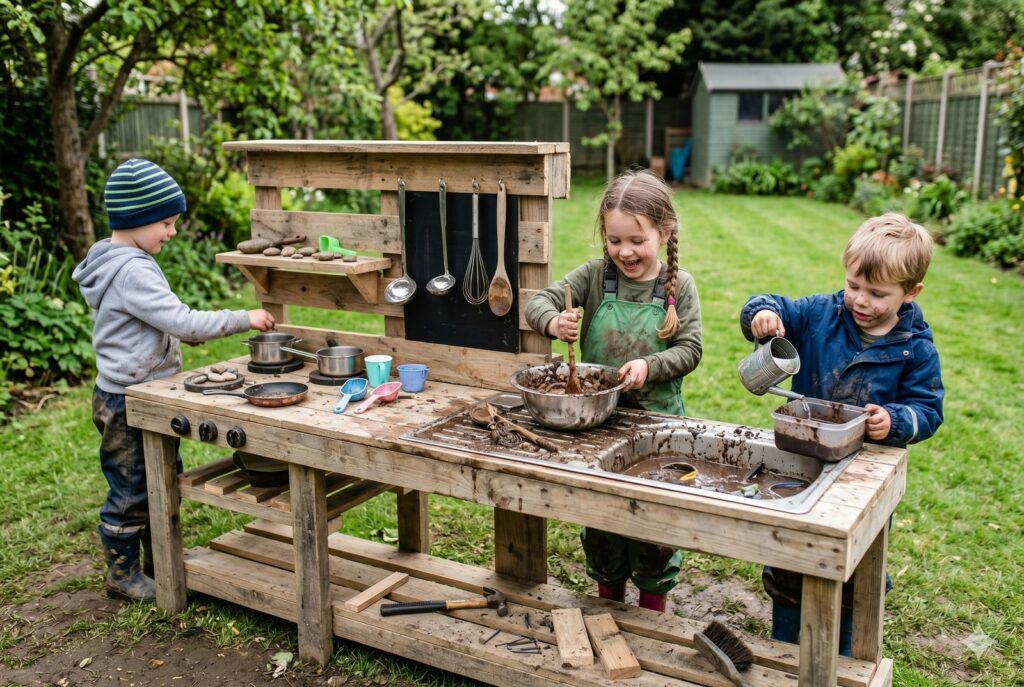
On TikTok and Pinterest it is the outdoor trend of 2026: the mud kitchen. A wooden play kitchen in the garden where children “cook” with water, sand, mud and leaves. No batteries, no screens, no instructions needed. The best part? You can build one in an afternoon. From pallet wood, scrap lumber or an old […]
What is wood glue?
Wood glue is adhesive made specially to join wood to wood. The most commonly used type is white wood glue based on PVA (polyvinyl acetate), but there are also PU glue (polyurethane), epoxy and traditional glues such as bone glue. A good wood-glue joint is often stronger than the wood itself: under load the wood […]
What are wooden floors?
Wooden floors are floors whose visible or load-bearing surface consists of wood. The term covers two things: the load-bearing structure of a wooden joist floor (a joist layer with floorboards on top) and the wooden finish floor that you lay over it, such as parquet, solid planks, engineered wood or laminate. Wood gives a warm, […]
What is timber construction?
Timber construction is building in which wood is the main load-bearing material, instead of brick, concrete or steel. This can be done with a frame of timber studs and rails (timber-frame construction) or with solid wooden panels and beams such as cross-laminated timber (CLT). Timber construction is on the rise because wood is light, quick […]
What is wood movement?
Wood movement is the movement of wood — shrinking and swelling — that occurs because wood absorbs and releases moisture. In a dry environment the wood releases moisture and shrinks; in a humid environment it absorbs moisture and expands. Because wood is a natural product that “breathes”, it keeps moving as long as it is […]
What about holes in wooden beams?
Holes or openings in a wooden beam or floor joist are sometimes unavoidable — for example for a pipe, cable or duct — but every hole weakens the beam. Where and how large you may drill or saw depends on the position in the beam, because a beam is loaded very differently in different places. […]
What is a hay barn (hay rick)?
A hay barn or hay rick is an agricultural structure in which hay, grain or other harvest was kept dry. Characteristic of the classic rick is the loose, height-adjustable roof that can move up and down over a number of straight standing poles (staves): as the stock grew, the roof was raised. This way the […]
What are blast-furnace slag and steel slag?
Blast-furnace slag and steel slag are by-products released during the making of iron and steel. They are stony materials that, after processing, are reused in construction — as a raw material for cement, as aggregate in concrete and as a base material in road construction. These are two different slags from two steps of the […]
What is blast-furnace cement?
Blast-furnace cement is a type of cement in which part of the Portland cement clinker is replaced by ground granulated blast-furnace slag, a by-product of iron production. In the European cement standard (EN 197-1) this is called CEM III. Because it contains less clinker and the slag is a useful raw material, blast-furnace cement has […]
What is main reinforcement?
Main reinforcement is the most important, load-bearing reinforcing steel in a reinforced concrete structure. It takes up the tensile forces that concrete itself can barely withstand, and lies in the direction where those forces are greatest — for example lengthwise at the bottom of a beam or at the bottom of a floor span. The […]