
What is a chain clause?
A chain clause (Dutch “kettingbeding”) is an obligation set out in a deed of sale or transfer that the buyer must impose on every subsequent buyer of the property or plot. In this way the obligation stays linked to the successive owners like a “chain”. Because such a personal obligation does not transfer automatically, a […]
What is a pile cap beam (kesp)?
A pile cap beam — Dutch “kesp” — is a short connecting beam of wood or concrete laid across the heads of two (or more) driven piles to tie them together. The whole of the beam with the piles beneath it is called a pile bent. The beam spreads the load of the masonry or […]
What is anti core-pulling protection?
Anti core-pulling protection (Dutch “kerntrekbeveiliging”) is protection against “core pulling”: a fast burglary method in which the intruder screws a bolt into the lock cylinder and yanks out the core (the inner workings) in one pull. Without the core, the lock can be opened in seconds. Anti core-pulling protection prevents this by shielding or reinforcing […]
What is nuclear energy?
Nuclear energy is the energy released when atomic nuclei are split (nuclear fission) or fused (nuclear fusion). In a nuclear power plant, heavy nuclei such as uranium are split; the released heat turns water into steam, which drives a turbine with a generator to produce electricity. The principle resembles an ordinary thermal power plant, but […]
What is the graveyard test?
The graveyard test (Dutch “kerkhofproef”) is a simple field test that determines the rot resistance (durability) of a wood species. A wooden stake — often about 5 × 5 cm — is driven partly into the ground, at the boundary between damp and dry where fungi are most active. Over the years it is monitored […]
What are the parts of a church?
A classic (Western European) church is built up from a series of fixed structural parts that together form the cross shape and the directed layout towards the altar. Knowing these parts helps in reading building drawings and naming historic churches. Below are the main parts, roughly from entrance to altar. The main parts Nave — […]
What is notch impact toughness?
Notch impact toughness (Dutch “kerfslagwaarde”) indicates how much energy is needed to break a standardised, notched metal test piece in a single blow at a given temperature. It is a measure of a metal’s toughness: the higher the value, the tougher the material and the more it deforms before it breaks. It is measured in […]
What is herringbone bond?
Herringbone bond (Dutch “keperverband”) is a laying pattern in which the stones meet at right angles to one another at an angle — usually 45° or 90° — forming a continuous zigzag or herringbone pattern. It is mainly used for paving, but also appears in decorative brickwork. The name refers to the resemblance to a […]
What is a herringbone edging stone?
A herringbone edging stone (Dutch “kepersteen”) is a specially shaped helper paver used to finish the edges of a pavement laid in herringbone pattern. Because the stones in a herringbone pattern sit at 45 degrees, each edge is left with a triangular gap. The edging stone has exactly that triangular or bevelled shape and fills […]
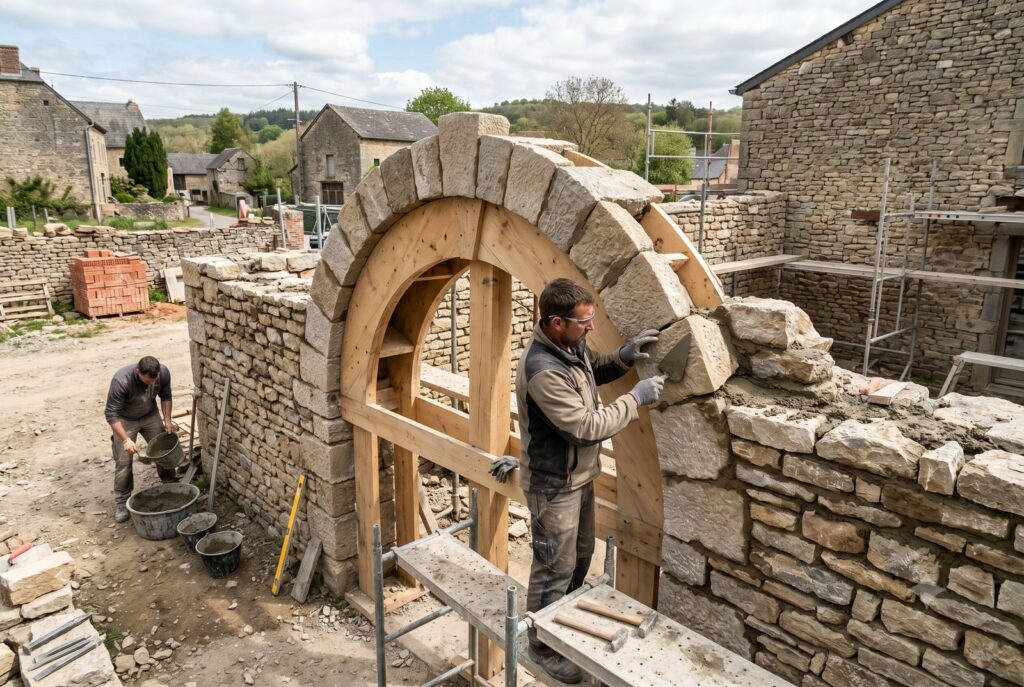
How to Build an Arch in a Wall: Complete Step-by-Step Guide (2026)
Open floor plans were the standard for years. Wall out, everything open, maximum sense of space. But more and more people are noticing the downsides: cooking smells throughout the house, no place to retreat, and a lack of atmosphere and character. The “broken floor plan” trend reverses that. Instead of fully open or fully closed, […]